





How to choose a coffee tamper, tamping mat and distribution tool
Good puck prep is three steps: spread the grounds evenly, tamp them level, and do it on a surface that won't mark your bench or portafilter. Choose the tamper first, because its size has to match your basket, then add the tools that suit the way you work.
Start with your basket size: 57 mm or 58 mm
Every hand tamper and distribution tool here comes in a 57 mm or 58 mm group size, or both, so check your machine's group first. If your basket measures under 57 mm across the top, none of them will fit. Within those sizes, Lelit points out that standard 57 mm and 58 mm tampers leave a gap between the edge of the base and the basket, and loose coffee left in that gap is where water can channel. That's why Lelit's tampers are 57.35 mm and 58.55 mm, and the Precise Fit tamper is 57.55 mm and 58.55 mm: the slightly larger base gives a closer fit.
Hand tampers: Lelit or Precise Fit
Choose the Lelit Coffee Tamper if you want a handle you'll enjoy using every morning. Lelit makes it for the 57 mm and 58 mm groups on its own Lelit espresso machines: the 57.35 mm for 57 mm group heads, the 58.55 mm for 58 mm. The polished wood or aluminium handle is shaped to sit in your palm. Guiding rings around the base help you keep it horizontal, and a small lip lets air flow around the base so it doesn't suck at the coffee as you lift it out. Walnut and ash, redwood and aluminium come in both sizes; maple, black walnut and zebrano are 58.55 mm only. Choose the Precise Fit Coffee Tamper from Jetblack Espresso if you want a plain flat base: the 57.55 mm suits 57 mm group heads and the 58.55 mm suits 58 mm group heads.
Distribution tools and WDT: an even bed before you tamp
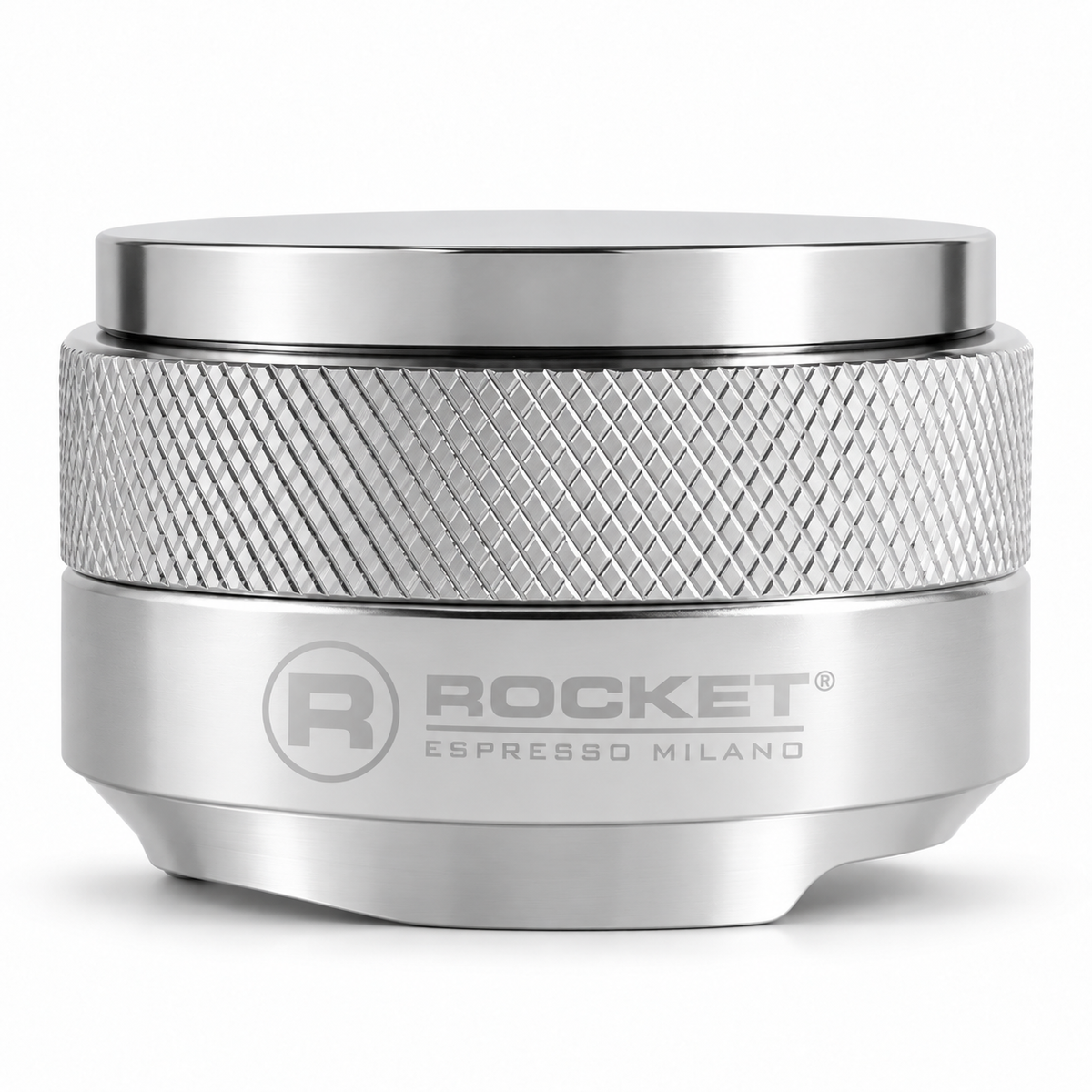
A distribution tool spreads the grounds before you tamp, so the bed has an even density and water doesn't find a weak spot. Choose the Lelit Distribution Tool to sit alongside your tamper: it has a brushed aluminium handle and a polished stainless steel base, adjusts in height for single, double and triple baskets, and comes in 57.35 mm and 58.55 mm. Choose the Rocket 2 in 1 Tamper Leveller if you'd rather have one tool: place the profiled side on the basket, twist it two to four times without pushing down, then flip it over and tamp with the other side. It is stainless steel, 58.3 mm across, adjusts for height to suit your dose, and comes in aluminium or matte black. For WDT, the Barista Progear Clump Crusher uses fine needles to break up clumps through the grounds before you level and tamp.
Tamping mats and tamping stations
A tamping mat or station protects your bench and your portafilter while you press. Silicone is the simple choice: the Rhino Classic Corner Tamper Mat is shaped to sit on the corner of your bench, extra thick to protect both the surface and the edge, and the Rhino Classic Tamper Mat is the compact flat version for the smallest benches. For a rigid stand, the Lelit Tamping Stand is brushed stainless steel on an anti-slip base and holds the portafilter level and balanced while you press. Lelit says it suits all its 58 mm and 57 mm portafilters. The Rocket Tamping Station from Rocket Espresso, in stainless steel and rubber, keeps the portafilter steady for even pressure and stops it marking your bench. If you have a Eureka Mignon grinder, its knock box drawer doubles as a tamping station.
Automatic tampers for cafés
If several baristas share a machine, an automatic tamper gives every shot the same pressure and takes the repetitive strain out of tamping. The Cinoart PT2 sits on the bench in a 127 by 127 mm footprint. Pressure adjusts from 2 kg to 38 kg, with one to three tamps per cycle, and its Guide Levelling System sets the portafilter level before it presses. Cinoart's standard head is 58 mm, for 58 to 58.3 mm baskets including VST, in spouted and bottomless portafilters, and a sensor means it presses only on a metal portafilter. The Cinoart PTB MY does the same job from under an Anfim or Mythos grinder, so you grind and tamp in one spot. See the full Cinoart range.
Delivery and advice
Orders over $200 ship free Australia-wide, and delivery under $200 is a flat $9.95. In-stock orders placed before 3pm Melbourne time are dispatched the same day. Not sure what suits your machine? Call or email us with the model and we'll help.
FAQs
What is the difference between a 58 mm and a 58.55 mm tamper?
Both are for machines with 58 mm group heads. The 58 mm figure is the nominal size, and the extra half millimetre closes the gap between the tamper base and the basket wall. Lelit says standard 58 mm tampers leave that gap, which is why its precise-fit base is 58.55 mm, and the Precise Fit tamper uses the same size. A precise-fit tamper should slide into the basket with very little clearance. If your basket is narrower than standard, a 58.55 mm base may be too tight, so measure the inside of the basket at the top first, or send us your machine model.
Will these tampers fit a 54 mm or 51 mm basket?
No. Every hand tamper, leveller and distribution tool in this range is sized for 57 mm or 58 mm baskets, and the Cinoart automatic tampers use a 58 mm head. A tamper made for a larger basket simply won't go in. If your basket is 54 mm, 51 mm or any other size under 57 mm, use the tamper that came with your machine or a replacement from its maker. To check your size, measure across the inside of the basket at the top, or look up the group size in your machine's manual.
Do I need a WDT tool or a distribution leveller?
They do different jobs, and plenty of baristas use both. A WDT tool such as the Barista Progear Clump Crusher has fine needles that you stir through the grounds to break up clumps, which matters most if your grinder clumps. A leveller such as the Lelit Distribution Tool or the Rocket 2 in 1 sits on the basket at a height you set and spreads the top of the bed flat as you twist it. If your grinder gives you fluffy, clump-free grounds, a leveller alone is often enough. If you see clumps, stir with a WDT tool first, then level and tamp.
Should I buy a tamping mat or a tamping station?
Choose a mat if you want something cheap, soft and easy to move. A food-grade silicone mat such as the Rhino Classic Tamper Mat protects the bench and the portafilter, and moves aside when you need the space. Choose a station if you want the portafilter held firmly while you press. The Lelit and Rocket stations are stainless steel stands that keep the portafilter steady and level, which helps you tamp straight, and Lelit's also keeps it off the worktop. A station takes a fixed spot on the bench, so measure before you order.
Is an automatic coffee tamper worth it for a café?
It pays off when consistency and baristas' wrists matter more than bench space. An automatic tamper presses at the pressure you set on every shot, so the result doesn't change with whoever is on the machine. The Cinoart PT2 stores three programmable settings, can tamp up to three times per cycle with a different pressure each time, and is fatigue tested to one million cycles. Its nano non-stick head stops fines and oils building up between shots. For a home bench or a quiet café, a precise-fit hand tamper on a good mat gives a level tamp for far less.
Why does coffee stick to my tamper when I lift it out?
Two things cause it. A close-fitting base can create suction as you pull it out of the basket, lifting the top of the puck with it. Lelit's tampers have a small lip around the base that lets air flow in and reduces that suction. Coffee oils and fines building up on the base also make grounds cling, which is why Cinoart coats its automatic tamp heads with a non-stick finish. With a hand tamper, wipe the base dry with a cloth between shots and lift it straight up, rather than twisting it on the way out.